Research & Development

Original research that makes stainless steel tanks safer and more reliable

R&D

Research That Makes Every Tank Safer

Beltecno carries out research and development to deliver safer, more reliable products. Our engineers develop original technologies grounded in fluid dynamics and structural mechanics, improving the performance of stainless steel tanks and the reliability of water infrastructure.

Research Themes

Four Original Technologies

Proprietary methods developed by Beltecno Corporation in Japan and presented in Japanese waterworks research.

01

Perforated Wall Method

The usual way to remove stagnant water from a reservoir is the baffle method: baffle plates are set alternately so the inflow snakes through the tank as a push-flow (Fig. 1a).

Beltecno’s perforated wall method replaces the baffles with walls across the full cross-section, pierced with holes about the size of the inlet pipe. The holes create a throttling effect that amplifies the inflow’s kinetic energy and drives a large circulating flow, so water reaches every corner in complete mixing.

We developed the method and its theory through our own fluid-dynamics research and were the first to propose it in Japan. FEM simulation and tracer tests in hydraulic model experiments have confirmed its validity.

Fig. 1 Flow velocity in a horizontal section (red = faster). (a) Baffle method: flow slows from the second chamber, leaving stagnant corners. (b) Perforated wall method: high velocity in every chamber, with no stagnant zones.

02

Ceiling Spring Theory

An analysis method Beltecno devised for steel rectangular tanks with a frame-and-panel structure. Adding spring elements to the ceiling plate (Fig. 2) aligns the displacement of the side walls and the internal frames, which differ in stiffness, under horizontal loads.

This turns the hard-to-analyse 3D structure of a rectangular tank with a trussed rigid frame into a 2D problem, making structural analysis simpler and more practical. Results closely match FEM simulation.

Fig. 2 Displacement of a rectangular tank and the resulting ceiling spring force.

03

Self-Supporting Wall Structure

In the conventional structure, each wall depends on the opposite wall for support (Fig. 3a). As tanks grow larger, load sharing between horizontal members and braces becomes increasingly inefficient.

Beltecno’s self-supporting wall structure (Fig. 3b) removes this inefficiency, making it possible to build steel rectangular tanks of up to 30,000 tonnes safely and at lower cost. It also frees up a large space in the lower part of the tank, making maintenance and inspection easier.

Fig. 3 (a) Conventional opposing-wall structure. (b) Beltecno self-supporting wall structure.

04

Natural Period Analysis

The natural period is a key parameter in seismic design. It changes with the type of internal reinforcement, the direction of vibration and the volume of water stored, yet no formula covered all of these factors.

Focusing on tanks built from connected units, Beltecno converted the tank into a beam model (Fig. 4) and applied Rayleigh’s energy method. In beam vibration theory, the maximum kinetic energy (Eq. 1) equals the maximum bending energy (Eq. 2). Substituting the relevant parameters gives Eq. 3, a natural period formula for rectangular tanks that covers every factor.

Note: This formula is based on Beltecno’s own research and is not a publicly available method.

Fig. 4 Beam model of a rectangular tank, with Eq. 1 to 3.

Testing & Verification

Proven Before It Reaches Your Site

Every design is backed by inspections, tests and research. Alongside static checks and simulations based on structural calculations, we collect seismic design data through vibration testing, using the seismic intensities of past earthquakes in Japan./

Seismic Vibration Table

Tanks are shaken at the intensities of past Japanese earthquakes. Maximum load 30 t on a 3.5 × 3.5 m table.

Structural Simulation

Static inspections and FEM simulations based on structural calculations verify every tank design.

Test Water Tanks

Physical test tanks confirm how our designs perform under real water loads.

Design Capability

Fully Welded Assembly

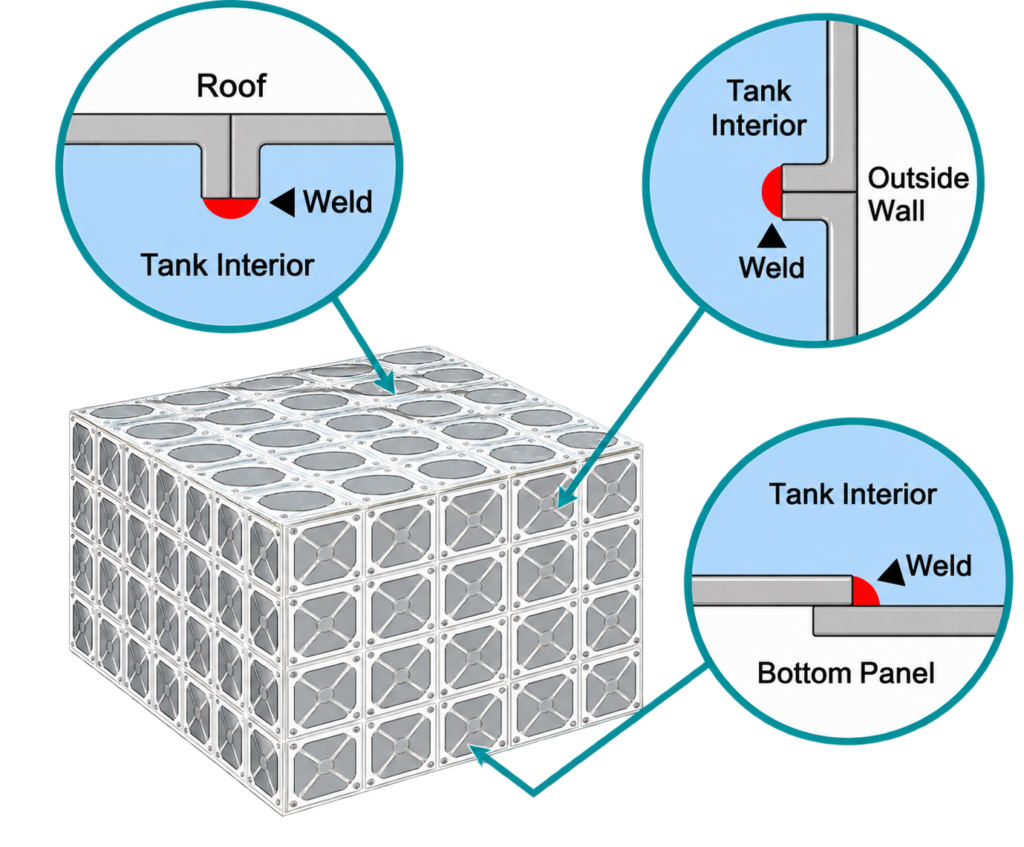
Research carries straight through to production. All parts are joined together by special welding, with no gaskets to wear or leak.

Our Factory

Beltecno India’s
Neemrana Factory

Beltecno builds the stainless steel tank that fits your exact requirements. Our SS304 and SS316L panel tanks are customizable from 1,000 litres to over 1 million litres. Backed by 75+ years of Japanese engineering and a Neemrana-based manufacturing facility, we deliver anywhere in India, from tender to installation.

Ready to discuss your water storage needs? Get a custom quote from our team — no obligation.